


%20(12).png)
If we rewind the clock just two years, digital advertising looked a hell of a lot different than it looks today. We were all impressed when AI could generate a cat that looked 80% like a cat. But here we are in March 2026, and the conversation has shifted entirely. We aren’t talking about "can AI do it?" anymore. We are talking about "how fast can it scale?" and "how high is the conversion rate?"
For publishers and advertisers in the AdMaven ecosystem, this shift is nothing short of a revolution. The days of waiting on a freelance graphic designer to return a single banner concept are over. The era of generic stock photos - those boring, soulless images of people shaking hands in a bright conference room - is dead. In its place is a dynamic, high-velocity creative environment where you are limited only by your imagination and your prompting syntax (and maybe a bit by tokens, but who’s counting?).
Still, there is such a thing as “too much choice”. There are hundreds of models out there, all claiming to be the "Midjourney killer" or the "next big thing." As performance marketers, we don't care about the hype; we care about the ROI. We need tools that integrate into our workflows, respect our specific vertical requirements, and ultimately drive the clicks that fuel our Pop, Push, and Interstitial campaigns.
Let us help you with your journey in this brave new world. We are going to give you the eight best tools you should be using right now for AI image generation.
The Strategic Edge: Using AI Without Getting Lost
Before we open the toolbox, we need to talk about strategy. Generative AI is a force multiplier, but it can also be a time sink if you don't treat it like a professional instrument. The biggest mistake we see advertisers make is "prompt fatigue." They spend four hours trying to get one image to look like a masterpiece, forgetting that in performance marketing, quantity and variety often beat perfection.
The winning strategy in 2026 is High-Velocity and Variation. Instead of asking AI for one perfect image, ask it for twenty options. Change the lighting, change the demographics of the model, change the background color from "corporate blue" to "urgent red."
This is particularly crucial for native ad widgets and push notifications. The lifespan of a creative in these formats is short - sometimes just a few days before CTR drops off a cliff. AI allows you to refresh your creative stack daily, keeping your ads invisible to "banner blindness."
Publishers need to leverage these tools to increase time-on-site. A wall of text doesn't hold attention like it used to. Custom, engaging imagery that perfectly matches the article's intent keeps users reading, scrolling, and interacting with your monetization units.
Now, let's look at the heavy hitters. These are the top 8 AI image creation tools that can help you monetize (and have fun while doing it).
Nano Banana 2
We have to start with the tool that just redefined the benchmark last week. Google officially dropped Nano Banana 2 (powered by the Gemini 3.1 Flash Image model) on February 26th, and it is a massive upgrade over the previous "Pro" iteration (even though Nano Banana Pro was amazing in its own accord).
The biggest news for advertisers isn't just the sub-second generation time; it's the Subject Consistency. The new model can now maintain perfect facial and clothing resemblance for up to five distinct characters in a single workflow. For a publisher or advertiser, this is the "holy grail." You can now generate a storyboard for a video ad or a sequence of native banners where your main character (let's say, a gamer holding a phone) looks identical in every single frame.
Google has integrated Real-Time World Knowledge directly into the generation layer. Unlike other models that hallucinate details, Nano Banana 2 pulls live visual data from Google Search. If you ask for a "current street view of Shibuya Crossing with rainy season fashion," it references real-time trends and architectural data to get the context 100% right.
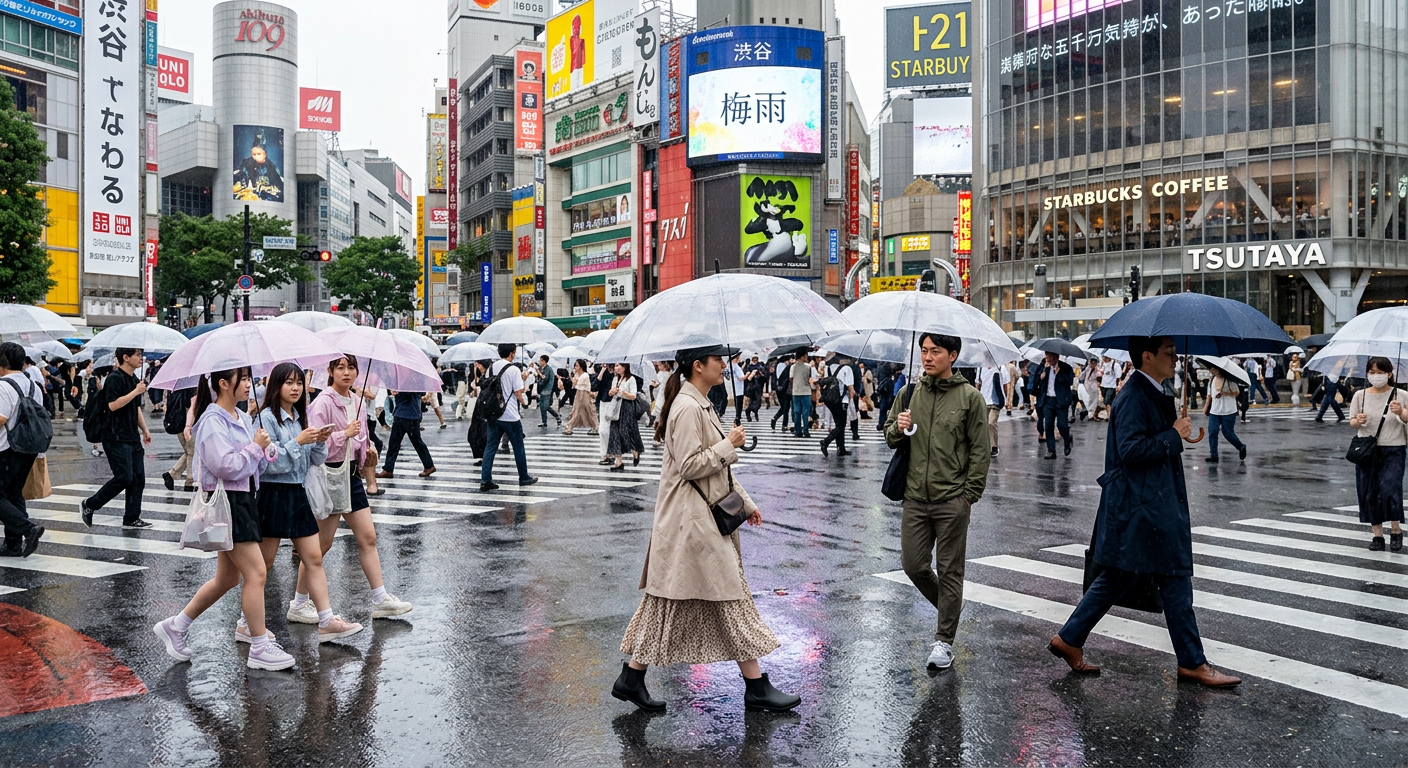
The Text & Localization feature is a game-changer for international campaigns. You can now generate an image with text in English, and then use the "In-Image Translation" feature to automatically swap that text to Spanish, Portuguese, or French while preserving the original lighting and texture of the text. For affiliates running global campaigns on our Pop and Push networks, this eliminates the need to use Photoshop to localize creatives for different geos. You can launch in 50 countries in 50 minutes.
Grok (Spicy Mode)
Let’s have an honest conversation about the verticals that actually drive a massive portion of the internet’s traffic: Dating, Social Discovery, and Nutra. The reality is that the major corporate AI tools have put massive safety guardrails in place. Try to generate a "flirty" image or a "romantic encounter" on most platforms, and you will get a lecture on community guidelines.

This is where Grok, specifically with its "Spicy Mode" engaged, has cornered the market. Developed by xAI, Grok was built with a philosophy of maximum freedom. While it still draws the line at illegal content (as it absolutely should), it is far more permissive when it comes to the "NSFW-lite" or "suggestive" content that fuels the dating vertical.
For advertisers running campaigns on AdMaven’s Pop-under or Interstitial networks, Grok is very useful. It can generate the kind of high-converting, attention-grabbing visuals that are required for adult-oriented offers without the constant fear of account bans. The image quality has improved drastically in the last year, moving from somewhat cartoonish to highly realistic skin textures and lighting, which is essential for believability in social discovery ads.
Ideogram 3.0
If you have been using AI tools since 2023, you remember the pain of text. You would ask for a sign that said "Welcome" and the AI would give you a sign that said "Welcccommee" written in alien hieroglyphics. It was a nightmare for anyone trying to make banner ads.
Ideogram 3.0 effectively solved this problem. It is currently the typography wizard of the AI world. This tool doesn't just "paste" text onto an image; it renders the text as a physical part of the scene. If you ask for a neon sign in a rainy window that says "50% OFF," the light from the letters will reflect correctly on the wet pavement, and the spelling will be perfect.
You can now generate your entire banner - background, subject, and CTA - in a single prompt. This often leads to higher trust from the user. It’s perfect for creating high-impact Push Notification icons where you have very limited real estate to convey a message.
Midjourney v7
Midjourney remains the heavyweight champion of pure artistic quality. While other tools focus on speed or text, Midjourney v7 focuses on beauty - and it’s still not matched in that department. The leap in version 7 has been all about "cinematography." The model now understands camera lenses, f-stops, and lighting rigs as if it were a professional director of photography.

This tool is the best friend of the high-end Publisher. If you run a content site and you want your articles to look premium, you cannot rely on generic stock photography. Midjourney allows you to create impressive, stylistic imagery that establishes a brand identity. Whether it’s hyper-realistic macro shots of technology for a gadget review site or ethereal, painted illustrations for a lifestyle blog, the output is stunning.
Adobe Firefly
In the wild west of AI, legal safety is the sheriff. For agencies managing large brand budgets or running campaigns for Fortune 500 companies, "mostly legal" isn't good enough. You need indemnification. You need to know that the model wasn't trained on scraped, copyrighted art.
Adobe Firefly is the safe harbor. It was trained exclusively on Adobe Stock images, open-license content, and public domain material. This makes it the cleanest model ethically and legally. But beyond safety, its integration into the Creative Cloud ecosystem is its superpower.
The "Generative Fill" and "Generative Expand" features are essential for resizing creatives. Let’s say you have a great 300x250 banner, but AdMaven’s inventory also has a slot for a 160x600 skyscraper. In the past, you’d have to crop the image awkwardly or start over. With Firefly, you simply drag the borders of the image out, and the AI paints in the rest of the scene to fit the new dimensions perfectly. It saves countless hours of production time.
Flux (Pro/Ultra)
When the open-source community felt abandoned by some of the earlier giants, Flux stepped in and took the crown. The Flux Pro and Ultra models are what we call "instruction followers." Most AI models drift; they get creative and ignore parts of your prompt. Flux is obedient to a fault.
If you are running a Sweepstakes offer - let's say for a "Titanium Blue iPhone 17 Pro Max" - accuracy is a must. You can't have the AI generate a phone with three buttons on the wrong side or the wrong camera array. Flux excels here. It follows complex descriptions.
You can give Flux a prompt like: "A hand holding a smartphone with a specific app interface on the screen, background is a blurred subway station, lighting is cold fluorescent, the person is wearing a red watch." Other models might forget the watch or mess up the screen. Flux executes the list like a checklist. This precision is vital for product-focused advertising where misrepresentation leads to user complaints and lower conversion rates.
Leonardo.ai
Consistency is the holy grail of branding. One-off images are great, but what if you need a mascot? What if you need the same character to appear in a video ad, a banner, and a landing page? Most AI tools struggle with this "object permanence."
Leonardo.ai has positioned itself as the asset factory for this exact problem. It allows you to train your own "finetuned" models. You can upload 15 images of your product or your character, and Leonardo will learn that specific concept.
This is a favorite among gaming advertisers. If you are promoting a mobile RPG, you can generate hundreds of assets featuring your main hero in different battle poses, environments, and levels, all retaining the exact same facial features and armor design. It creates a cohesive user journey from the first impression on the ad to the actual gameplay, which significantly reduces churn.
Canva AI
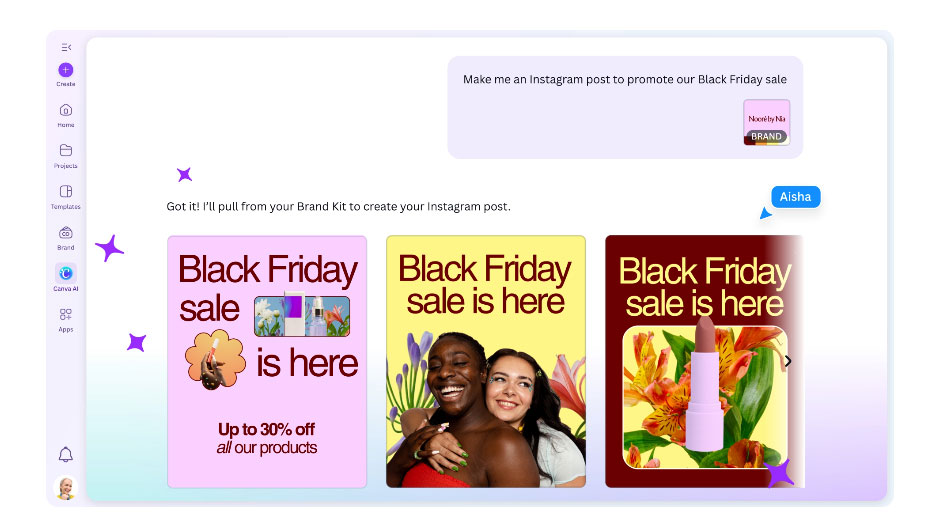
Finally, we have the great democratizer. Not every affiliate marketer is a Prompt Engineer, and not every publisher has time to mess around with discord bots or API keys. Canva has brilliantly integrated various AI technologies (a mix of their own tech and partnerships with major labs) directly into their "Magic Media" suite.
Their model is not technically superior to Midjourney, but it is much easier to use. You are already in Canva to build your ad layout. You are already there to add your button and your headline. Being able to generate the background image right there in the same sidebar is a workflow efficiency that cannot be beaten.
For rapid testing, Canva is king. You can generate an image, drop it into a "Social Media Ad" template, apply your brand kit colors, and export it in thirty seconds flat. When you are launching a new campaign and want to test ten different angles across five different formats, this friction-less workflow is what allows you to scale up before your coffee gets cold.
The Final Verdict
The "best" tool ultimately depends on your specific bottleneck. Do you need the amazing features of Nano Banana 2? The unregulated freedom of Grok? The typographic precision of Ideogram? Or the legal safety of Adobe Firefly?
The most successful marketers we see in 2026 aren't loyal to just one. They use a stack. They might generate a base image in Midjourney, expand the background in Firefly, add text in Ideogram, and do the final layout in Canva. Test them all. You can always unsubscribe if you need to, and the pricing is reasonable.
The barrier to entry for high-end creative work has collapsed. The only variable left is your willingness to experiment. The traffic is there. The tools are there. The only thing missing is your campaign.
AdMaven is ready to take those stunning creatives and put them in front of billions of users. Our network is optimized to work with the high-velocity, high-impact visuals that these AI tools generate. Don't let your beautiful ads sit on a hard drive - let them run wild on our premium inventory.
Register for an AdMaven Advertiser Account today and turn your AI creatives into revenue!


